
Rental or purchase? The better choice depends less on the price of the LED screen itself and more on how often you will use it. For occasional events, rental keeps upfront costs and operational work low. For frequent events or permanent installations, purchasing can deliver better long-term value and control.
If you are planning an event, opening a new venue, or building an in-house AV system, there is no one-size-fits-all answer. The real question is simple: How often will you actually use the screen?
What Is the Difference Between Renting and Buying an LED Screen?
At a basic level, renting an LED display is an approach: you pay for the equipment and services when you need them. Purchasing is a approach: you make a larger upfront investment and take responsibility for the equipment over its useful life.
Rental is often easier because the rental company can handle delivery, installation, technical support, removal, and storage. You use the screen, then hand it back.
Buying gives you something different: ownership. Once the system is installed, you can use it whenever you need it without paying a rental fee every time. But ownership also means taking care of transportation, storage, maintenance, repairs, upgrades, and eventual replacement.
So the decision is not simply “Which one is cheaper?”. It is “Which cost structure fits the way we use LED displays?”
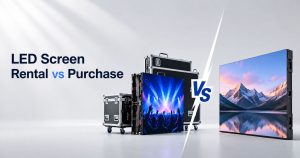
When Does Renting an LED Screen Make More Sense?
For businesses that only need an LED screen a few times a year, rental is usually the easier choice. Think about a company that hosts one annual conference, a product launch, or a few trade shows. Buying an entire LED system may leave expensive equipment sitting in storage for most of the year.
Rental also makes sense when the display requirements change from project to project. One event might need a large indoor screen, while another may require an outdoor display, a curved configuration, or a different pixel pitch. With rental, you can choose the right specification for each project instead of owning one system and trying to make it work everywhere.
As a general planning rule, low-frequency users—especially those using LED displays only a handful of times per year—should start by comparing rental costs against the full cost of ownership, not just the purchase price. And remember: a rental quote may include more than the screen itself. Installation, dismantling, transportation, technicians, spare parts, and on-site support can all be part of the package.
When Is Buying an LED Screen the Better Investment?
Buying becomes more attractive when the screen is going to work regularly. For event companies, rental companies, conference venues, churches, retail stores, corporate spaces, and businesses running frequent presentations, repeated rental fees can eventually cost more than owning the equipment.
The calculation is fairly straightforward: Annual rental cost × expected years of use vs. purchase price + ownership costs
But there is another factor that is easy to overlook: control. When you own the screen, you are not limited by another company’s inventory or availability. You can schedule an event at short notice, customize the configuration, and keep the same visual quality across multiple events.
For a permanent installation, the decision is even clearer. If an LED display will stay in a showroom, lobby, retail environment, auditorium, or outdoor advertising location for years, renting usually adds little value. Purchasing gives you a long-term asset instead.
What About Technology Changes and Depreciation?
LED technology moves quickly. Pixel pitches get finer. Processing becomes more powerful. COB and other new packaging technologies continue to develop. What looks cutting-edge today may become a standard specification a few years later. This creates an important difference between rental and ownership. With rental, technology risk is largely shifted to the rental provider. If a newer display becomes available, you can choose it for your next project.
With ownership, the equipment remains your asset—and your responsibility. That does not necessarily make buying a bad decision. It simply means the purchase should be based on how long you realistically expect the system to remain useful.
For businesses that use LED displays heavily for several years, depreciation may be acceptable because the equipment is generating value throughout that period. For businesses that use a screen only occasionally, technology depreciation can be harder to justify.
What About Storage, Logistics, and Technical Support?
This is where ownership often becomes more complicated than expected. LED displays are not small pieces of office equipment. Cabinets, flight cases, power supplies, cables, spare modules, and structural components all need space. If you own a rental-style LED system but only use it occasionally, you may end up paying for storage long before you pay for the next event.
Transportation is another consideration. Moving a large LED display requires proper packing, handling, and logistics. Frequent transportation can also increase the risk of cabinet damage, module damage, or connector problems. Rental shifts much of this operational burden to the service provider. That can be especially valuable for businesses without an in-house AV team.
Could a Hybrid Approach Be the Smartest Option?
For many businesses, the answer does not have to be rental or purchase.
A hybrid approach can work surprisingly well.
For example, a company might purchase a standard LED display for weekly meetings, presentations, and regular events. When it hosts a major annual conference, it can rent additional cabinets, larger screens, specialty configurations, or different pixel pitches.
This gives the business a reliable core system without forcing it to own every type of LED display it might need once or twice a year.
It is a bit like owning the tools you use every week and renting the specialized tools you only need occasionally.
So, Should You Rent or Buy an LED Screen?
Rent if: you use LED displays occasionally, need different specifications for different events, want to minimize upfront investment, or do not want to manage storage and maintenance.
Buy if: you use LED displays frequently, operate a permanent installation, need immediate access to the equipment, or want to build long-term value from the investment.
Consider a hybrid model if: you have regular display needs but also host occasional large or specialized events.
Before making a decision, calculate the total cost of ownership, not just the purchase price or daily rental rate. That one step can turn a complicated AV decision into a much clearer business case.
Häufig gestellte Fragen
1. Is it cheaper to rent or buy an LED screen?
It depends on how often you use it. Rental is usually more cost-effective for occasional events, while frequent users can often achieve a lower cost per deployment through ownership.
2. How many times a year should I use an LED screen before buying?
There is no universal break-even number because rental rates, purchase prices, installation, storage, and maintenance vary. As a starting point, businesses using LED displays regularly throughout the year should calculate a three- to five-year total cost comparison rather than relying on a simple industry rule.
3. Does renting include installation and technical support?
Often, yes. Many professional rental packages include delivery, installation, dismantling, technicians, and basic technical support. Always check exactly what is included in the rental agreement.
4. What happens when a purchased LED screen becomes outdated?
You can continue using it, upgrade selected components, relocate it to another application, or resell it. The key is to consider the expected useful life and upgrade path before purchasing.
5. Is buying better for permanent LED installations?
In most cases, yes. For a screen that will remain in a retail store, corporate lobby, auditorium, control room, or advertising location, purchasing usually makes more sense than paying recurring rental fees.
6. Can I combine rental and purchase?
Absolutely. A hybrid strategy can be a practical option: purchase the LED displays you use frequently and rent additional or specialized equipment for large events.
Final Takeaway
There is no universal winner in the LED screen rental vs. purchase debate. Rental gives you flexibility, lower upfront costs, and less operational responsibility. Purchase gives you control, availability, and the potential for better long-term economics when the equipment is used frequently.
The smartest approach is to start with one question: How often will this LED screen actually be working? Once you know that, compare the full cost—not just the screen price—and the right choice becomes much easier.
If you are comparing LED display options for an upcoming project, explore CLT’s LED display solutions to see which display type, pixel pitch, and configuration fits your application.