
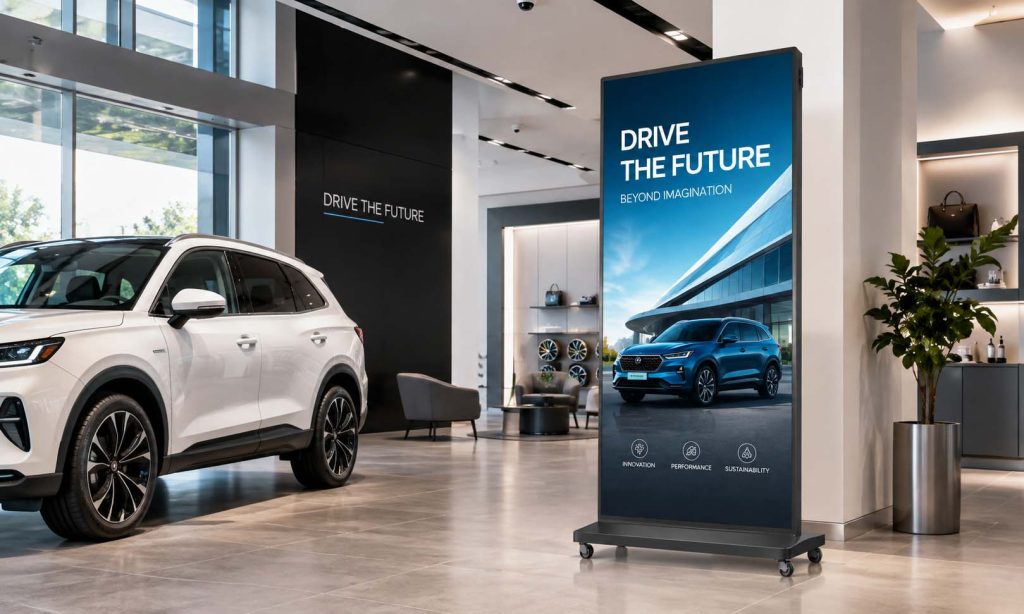
A plug and play LED poster screen is ideal for showrooms that need high-impact visuals without permanent installation. It is easy to move, quick to set up, simple to manage, and flexible enough to work as a standalone display or a larger seamless video wall.
Nowadays, more brands are turning to movable direct-view LED poster displays because they combine the visual impact of LED with the flexibility of a freestanding display.
What Is a Plug and Play LED Poster Screen?
A plug and play LED poster screen is a freestanding digital display designed for quick deployment with minimal technical setup. It does not require a permanent wall structure or complicated installation. Built-in wheels allow the screen to be repositioned as the showroom layout changes. This makes it particularly useful for showrooms, retail stores, brand experience centers, hotel lobbies, and temporary exhibitions.
Why Is Mobility Important in a Showroom?
Showrooms rarely stay the same for long. A new product arrives. A campaign changes. A launch event takes over the space. movable LED posters make these changes much easier. Once it is in position, simply connect the power and start playing content. The real advantage is not just mobility. It is freedom from fixed layouts.
LED Posters Can Be Combined Into One Large Screen
A single LED poster can work as a standalone display, but multiple units can also be connected to create a much larger visual canvas. For example, 6 CLT X-Poster displays can be combined into a large seamless 16:9 ratio display. HDMI loop-through and mobile-app configuration can make the splicing process straightforward.
This gives showrooms more flexibility: use individual screens for different products on a normal day, then combine them into one large display for a product launch or promotional event.
Easy Content Management
A display should not require a technician every time you want to change a video. Many plug and play LED poster systems come with a built-in operating system, often Android-based, and an intelligent control card. Depending on the configuration, content can be updated through Wi-Fi, 4G, or USB using a laptop, tablet, or smartphone. That means staff can quickly replace product videos, update promotions, or prepare event content without physically connecting complicated control equipment. For businesses with multiple locations, cloud-based management can also make it easier to update content across different showrooms.
COB, GOB, or SMD: Which One Should You Choose?
| Technology | Best For | Key Advantage |
| COB | Premium close-up viewing | High contrast, wide viewing angle, smooth and protected surface |
| GOB | High-traffic environments | Strong resistance to impact, dust, moisture, and static |
| SMD | Longer viewing distances | Cost-effective, mature technology, easy maintenance |
COB: For Premium Showrooms
Chip-on-board (COB) technology places LED chips directly onto the PCB and covers them with a continuous protective layer. The result is a smooth surface, strong contrast, wide viewing angles, and more uniform light diffusion. COB is particularly suitable for luxury showrooms, premium brand spaces and other environments where visitors may view the screen from less than 1.5 meters.
GOB: For Busy, Interactive Spaces
Glue-on-board (GOB) adds a transparent protective layer over SMD modules. Its biggest advantage is physical protection. GOB can provide stronger resistance to impact, dust, moisture, and static, making it a practical option for busy retail floors, experience centers, and interactive areas.
SMD: A Practical Choice
Surface-mount device (SMD) remains a popular option because of its balance between performance, cost, and maintainability. For larger displays viewed from around 2.5 meters or more, where visitors are unlikely to touch the screen, SMD can be a cost-effective choice. The best technology is not necessarily the most expensive one. It is the one that matches your actual showroom environment.
FAQ
Are LED poster screens really plug and play?
Yes. They are designed for fast deployment with minimal installation. In a typical setup, simply position the screen, connect the power, and start playing content.
Can I move an LED poster around my showroom?
Yes. Movable LED posters use wheels or casters, allowing staff to reposition them without permanent installation.
Can multiple LED posters be connected?
Yes. Multiple units can be combined into a larger seamless display, making them suitable for both everyday signage and large promotional campaigns.
Which is better: COB, GOB, or SMD?
COB is ideal for premium close-up viewing, GOB is better for high-traffic environments, and SMD is a practical choice for longer viewing distances and cost-sensitive projects.
Can employees update the content themselves?
Yes. Depending on the configuration, content can be updated through Wi-Fi, 4G, USB, or connected devices without requiring specialist technical support.
Conclusion
A plug and play LED poster combines the visual impact with the flexibility of a movable display. It can move with your showroom, scale into a larger screen when needed, and make everyday content updates much easier. For premium close-up experiences, consider COB. For high-traffic environments, GOB can provide additional protection. For cost-effective applications with longer viewing distances, SMD remains a practical choice.
Looking for a flexible LED display for your showroom? Explore CLT’s LED Poster Display solutions and find the configuration that fits your space.