
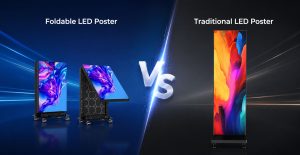
At first glance, foldable led poster and traditional led poster look pretty similar. Both are designed as digital alternatives to traditional printed posters, using LED pixels to display advertising, videos, images, and event content. The biggest difference isn’t the picture quality. It’s what happens when you need to move the screen.
Traditional LED Posters typically use a rigid, single-panel structure. Once installed, the screen stays in its fixed portrait format. Foldable LED Posters divide the display into rigid cabinet sections connected by hinges. The LED modules themselves don’t bend. Instead, the cabinet sections fold together for transportation and unfold into a larger display when needed. That simple structural difference changes everything from logistics to setup.
What Do They Have in Common?
Before looking at the differences, it’s worth noting that both technologies can deliver professional LED performance.
1. High-Quality Visuals
Both can offer high brightness, strong contrast, and refresh rates of 3,840 Hz or higher, making them suitable for commercial environments and camera recording. Fine pixel pitches such as P1.25 to P2.5 can also provide sharp text and detailed images for close viewing.
2. Flexible Content Control
Both can support synchronous playback through HDMI/PC connections as well as asynchronous content updates through USB, Wi-Fi, LAN, or cloud-based management. Multiple units can also be cascaded to create a larger seamless display.
3. Easy Front Maintenance
Front-service LED modules allow technicians to replace individual modules without dismantling the entire display structure. With proper operation and maintenance, professional LED displays can offer a service life of up to 100,000 hours.
So, if you’re comparing image quality alone, there may not be a huge difference. The real story starts with the structure.
1. Portability
This is where foldable LED Posters have the biggest advantage. A traditional poster keeps its full dimensions during transportation. A typical 1.9-meter-high display can be awkward to move through elevators, corridors, vehicles, and exhibition halls.
A foldable model can collapse to roughly half its deployed size, with some designs reducing transportation volume by 50%–60%. For companies that frequently ship displays between cities or countries, that can mean less storage space, easier handling, and potentially lower logistics costs.
2. Setup Time
Traditional LED Posters are relatively simple to operate, but getting the full-size unit into position can still require two people, especially in tight venues. Foldable models are designed with mobility in mind. The basic workflow is simple:
Roll → Unfold → Lock → Power On
Depending on the model, one person can often complete setup in around 1–2 minutes without special tools. That matters when you’re setting up multiple displays at a trade show or moving between different event locations.
3. Display Flexibility
Traditional LED Posters generally stay in a single vertical configuration. Foldable LED Posters can offer more creative possibilities. When fully unfolded, several cabinet sections can create a wider display for landscape content. Some designs can also fold into a double-sided configuration, allowing content to face two directions. So instead of being just a digital poster, a foldable model can become a reconfigurable display solution.
4. Durability and Maintenance
A rigid poster has fewer moving parts, which means there are no hinges or folding joints to inspect. Foldable models contain hinges, alignment systems, and locking mechanisms. If the display is transported and folded frequently, these components need regular inspection. For rental and mobile applications, LED protection is also important. Technologies such as GOB or COB encapsulation can help protect LED components from bumps and repeated transportation. So don’t just ask whether a screen can fold. Ask whether it can keep folding reliably after repeated use.
Which One Should You Choose?
The decision becomes much easier when you look at where the display will actually be used.
Choose a Traditional LED Poster If:
- The display will stay in one location.
- You prioritize structural simplicity.
- You need a long-term retail or commercial installation.
- Transportation isn’t a regular concern.
- You want to minimize mechanical maintenance.
Typical applications include retail stores, shopping malls, hotel lobbies, showrooms, and corporate spaces.
Choose a Foldable LED Poster If:
- The screen needs to travel frequently.
- Fast setup is important.
- Storage and transportation space are limited.
- You need multiple display configurations.
- You’re building a rental fleet.
Typical applications include trade shows, exhibitions, roadshows, pop-up events, product launches, and rental projects.
FAQ
1. Is a foldable LED poster better than a traditional LED poster?
Not always. A foldable LED Poster is better when portability, fast setup, and flexible layouts are important. A traditional LED Poster is often more practical for permanent installations because it has fewer mechanical components and doesn’t require hinge maintenance. Both can provide similar LED image quality, fine pixel pitches, high brightness, and flexible content management.
2. How much space can a foldable LED poster save?
Depending on the design, a foldable LED Poster can reduce transportation volume by around 50%–60% when folded. This makes it easier to transport in smaller vehicles and store in limited spaces.
3. Can a foldable LED poster be double-sided?
Yes, some foldable LED Posters support double-sided configurations. By folding the screen, LED surfaces can face opposite directions and display content to two different audiences. This can be useful in shopping malls, exhibitions, event entrances, and other areas with traffic coming from multiple directions. However, this feature depends on the specific product design.
4. Are foldable LED posters suitable for rental?
Yes. Their compact transportation size, fast setup, and flexible configurations make them particularly suitable for rental applications. However, frequent folding and transportation mean that hinge quality, locking mechanisms, cabinet construction, and LED protection are especially important.
5. Which is better for exhibitions?
For most exhibitions, a foldable LED Poster is the more flexible choice. It is easier to transport, faster to set up, and can offer wider or double-sided configurations. Traditional LED Posters can still work well, especially when the display will remain in one position throughout the event.
Final Takeaway
Traditional and foldable LED Posters share the same basic goal: replacing static posters with brighter, more engaging digital content. But they are designed for different working styles. Traditional LED Posters prioritize stability and simplicity. Foldable LED Posters prioritize portability and flexibility.
If your display stays in one place, go with the simpler structure. If it travels from exhibition to exhibition, city to city, or event to event, foldability can make a much bigger difference. The best LED Poster isn’t necessarily the one with the most features. It’s the one that fits the way you actually use it.
For more options, explore CLT LED Poster Display solutions and find the right configuration for your retail, exhibition, roadshow, or rental application.