
A fixed installation LED display is a permanent wall — mounted, suspended or built into the structure, with no casters and no folding mechanism. Because it stays put for years, the decisions that matter are different from those for a movable screen: viewing distance fixes the pixel pitch, the environment fixes the panel type and protection, and service access fixes the wall design before anyone talks about price.
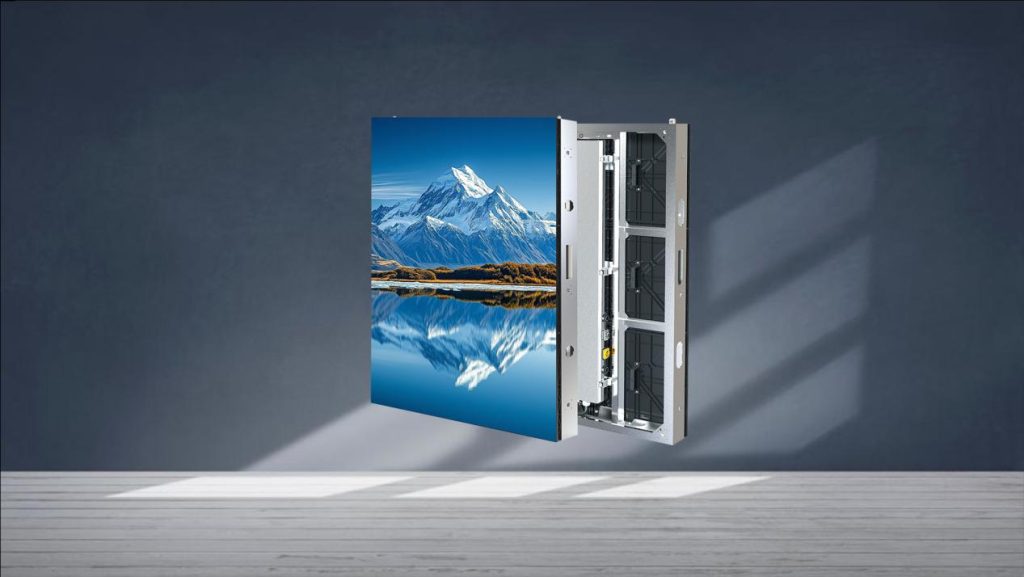
Four variables narrow a fixed installation LED display down faster than any specification sheet: viewing distance, indoor or outdoor, front or rear service, and cabinet module size. Get those four right and the series usually selects itself.
Decision 1: Viewing Distance Sets the Pixel Pitch
Pixel pitch is the distance between LED pixels, and the useful rule is roughly one millimetre of pitch per metre of closest viewing distance for critical viewing. A control room where operators sit three metres away behaves very differently from a shopping-mall façade viewed from thirty metres.
The common mistake is buying a finer pitch than the audience can resolve. It raises cost without improving the perceived image, and it adds heat and power draw. If nobody stands closer than six metres, a P2.5 wall is doing the same job as a P1.3 wall at a fraction of the budget. For a fixed installation LED display, this is the single line where most of the budget is won or lost.
Decision 2: Indoor or Outdoor Sets the Panel
Indoor walls optimise for close viewing and colour consistency under controlled light. Outdoor walls optimise for brightness against daylight, weather protection, and heat. These are not the same product with a different label — the cabinet sealing, cooling path and brightness headroom all change. Outdoor projects also need the IP rating confirmed for the specific model rather than assumed from the category.
Decision 3: Front or Rear Service Sets the Wall
This is the decision that most often gets made too late. A front-service cabinet lets a technician replace a module from the audience side, so the wall can sit flush against a wall. A rear-service cabinet needs a service corridor behind it — typically a walkable gap — which changes room layout, structure and cost.
Choose rear service when the corridor exists and modules are large; choose front service when the wall is flush-mounted, suspended, or installed in a finished interior where nobody wants a maintenance aisle behind it.
Decision 4: Cabinet Module Sets the Real Dimensions
Walls are built in whole cabinets, so the finished size is a multiple of the cabinet module, not an arbitrary number. A 500 × 500 mm cabinet system builds walls in 0.5 m steps; a 600 × 337.5 mm system follows a 16:9 logic; a 960 × 960 mm outdoor cabinet builds in roughly one-metre blocks.
Measure the available opening, then divide by the cabinet size, and accept the nearest fit. Planning a 4,000 mm wall with 960 mm modules leaves you either a gap or an overhang — a detail that shows up on installation day.
The Indoor Range, Line by Line
The indoor half of the fixed installation LED display range splits by cabinet logic rather than by price. The table below reflects what each series is specified for on the product pages.
| Series | Type | Cabinet | Pixel pitch | Service |
| H3 | SMD | 500×500 / 500×1000 mm | P1.6 – P4.8 | Front / Rear |
| HD | SMD | 500×1000×40 mm | P1.6 – P3.9 | Front |
| LM2 | SMD | 600×337.5×39.6 mm | P1.3 – P2.5 | Front / Rear |
| LM Pro | SMD | 600×337.5×28 mm | P0.9 – P2.5 | Front |
| LM C3 | COB | 600×337.5×29 mm | P0.8 – P1.6 | Front |
| LX 3 | SMD / COB | 640×480 mm | P1.3 – P2.5 | Front |
| LX-O | SMD | 640×480×69.9 mm | P1.3 – P2.5 | Front |
Read across the pitch column and the pattern is clear. The 16:9 cabinet families (LM2, LM Pro, LM C3) are designed for meeting rooms, control rooms and anywhere content arrives in 16:9. The finer pitches sit in the COB option, which also brings a more robust surface for spaces where the wall is within reach. The 500 × 1000 and 640 × 480 families trade 16:9 proportions for build flexibility and easier module handling.
The Outdoor Range, Line by Line
| Series | Positioning | Cabinet | Pixel pitch | Service |
| T | High-brightness billboard | 960×960×108 mm | P4.0 – P10.0 | Rear |
| TA | Low-power commercial | 960×960×84.8 mm | P4.4 – P10.0 | Front / Rear |
| TB | High-refresh commercial | 500 / 750 / 1000 mm | P3.9 – P4.8 | Front / Rear |
| TC | Stadium perimeter | 640×960×98 mm | P5.0 – P10.0 | Front |
| TD | Stadium display | 640×640×77.5 mm | P2.5 – P3.1 | Rear |
Outdoor choices hinge on where the wall stands and who is looking. A street-facing billboard read from thirty metres does not need the pitch of a stadium display read from a stand, and a perimeter ribbon is built in a different proportion because it is viewed along the ground rather than head-on. Low-power models matter where electricity is metered or solar-supplied.
What to Prepare Before Requesting a Quote
Send these eight items and most of the back-and-forth disappears:
- Wall opening dimensions, height and width, plus a photo of the space
- Closest and farthest viewing distance
- Indoor or outdoor, and whether direct sun hits the wall
- Mounting method: wall, suspended, embedded or floor-standing
- Whether a service corridor exists behind the wall
- Structure type and load capacity
- Content type: video, data, text, live camera feed
- Signal source and whether it will be filmed
FAQ
What is the difference between fixed installation and rental LED display? Fixed installation is built to stay in place: permanent mounting, tighter tolerances, no quick-lock hardware. Rental cabinets prioritise fast assembly, touring protection and repeated handling.
Do I need front service or rear service? Front service suits flush-mounted and suspended walls with no access behind. Rear service needs a walkable corridor but simplifies module replacement on large cabinets.
Can a fixed LED wall be curved? Some cabinets support curved assembly, and dedicated curved models exist. Confirm the minimum radius with the supplier before designing around it.
How is the final wall size decided? In whole cabinets. Measure the opening, divide by cabinet dimensions, and pick the closest fit; a designer can then absorb the difference with a frame.
Should I choose a finer pixel pitch than my distance needs? No. Pitch should match the closest viewing distance. A pitch finer than the audience can resolve adds cost, heat and power without a visible gain.
Next Step
CLT’s fixed installation LED display range covers six indoor and six outdoor series, from P0.8 fine-pitch COB walls to P10 outdoor billboards, in cabinet modules from 500 × 500 mm to 960 × 960 mm. Send the wall dimensions, viewing distance and whether service access exists behind the wall — those three answers narrow twelve series down to two.